


This isn't a pitch for my app. It either works for you or it doesn't. What matters is finding a system that actually fits how you work. Here's how I found mine.
The infinite list problem
Every productivity app lets you add infinite tasks. This feels like freedom. It's actually permission to lie to yourself.
You add "Learn 5 characters a day" and "Rewrite the website" and "Research health insurance" and 47 other things you'll absolutely do in the coming months. The app accepts them all. It organises them beautifully. It sends you reminders.
You don't do them. The list grows or you cancel the stale ones.
The app's infinite capacity enables your denial. It stimulates procrastination. You pretend you'll eventually get to everything if you just organise better, prioritise smarter, or use the new AI feature that suggests optimal task ordering.
You won't. The math doesn't work. You have 50 tasks sprawling every corner of your life in a blender. No amount of organisation fixes that.
Why I built this
I tried every productivity app. Todoist. Notion. Things. ClickUp. Trello. Various frameworks and systems.
Each one worked for two weeks. Then I'd open it, see the backlog I'd created, and close it.
I always came back to pen and paper. One page per day. Top three tasks at the top and keep copying over. Everything else below. Simple. It's still my preferred way of working. Something about scribbling out a finished task is satisfying. But it has limitations. Portability being the main one. I moved it to my Scribe, but again, it's not something I carry everywhere.
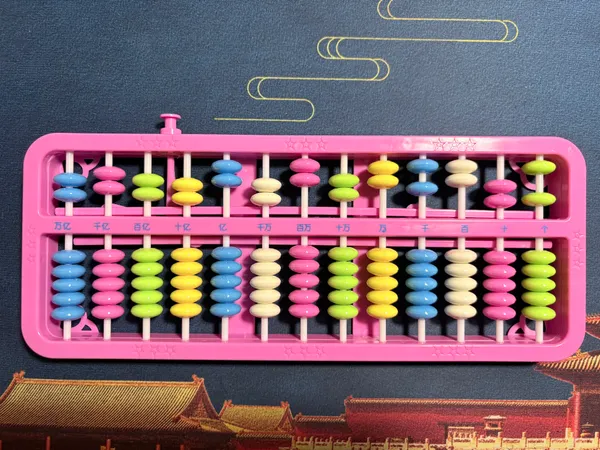
Over the summer my daughter found an abacus. A toy she picked up when she was one. It was part of a set of 12 or 24 trinkets the twins crawled and picked up. The first 1 or 2 were meant to be a sort of "chosen path" for their future calling.
She slid beads up. Slid beads down. Organising by position. Limited by capacity.
That mechanical limitation was exactly what I needed. So I tried to build an Abacus for tasks.
Three rods, ten beads each
Suanpan, my task management tool, has three rods:
Mine: Your health, sanity, personal growth. The stuff that keeps you functional.
Family: The people who matter. Dentist appointments. Anniversary planning. That leaky sink.
Work: The stuff that pays bills. Proposals. Emails. Quarterly reviews.
That's it. No custom columns on day one. No "Projects" section. No "Maybe" bucket.
The order matters too. You take care of yourself first, people second, then work. Most systems let you pretend work comes first until you burn out. Suanpan builds the sequence into the structure.
The forcing function
Each rod holds 10 tasks maximum. That's 30 total tasks across your entire life at any moment.
The 10-task limit isn't a bug. It's the point.
When you can't add an 11th task, you face a real decision: delete something that doesn't matter, finish something to make space, or admit you're overcommitted.
Most apps let you add infinite tasks, then optimise the order. Suanpan forces you to choose what even gets on the list. That's where the real productivity decision happens.
The prioritisation algorithm uses urgency (time-sensitive) and importance (impact-driven). If it sounds familiar, it's because it's based on the Eisenhower Matrix:
| Urgent | Not Urgent | |
|---|---|---|
| Important | DO FIRST • Crisis management • Deadlines • Emergency issues |
SCHEDULE • Strategic planning • Personal development • Relationship building |
| Not Important | DELEGATE • Interruptions • Some emails/calls • Other people's priorities |
ELIMINATE • Time wasters • Busy work • Excessive social media |
The cardinal rules
1. Tasks that take 2-5 minutes should never even factor into the equation. Just do them. If the task is responding to an email, just snooze it in your email. It's not a task, when you get the reminder just answer.
2. If you put a due date, stick to it. This is your discipline. If you book a flight, you don't turn up the day after it's left.
3. If you mark a task as important, it better be important. Refer to the Eisenhower Matrix.
4. Always work top to bottom, left to right. As much as you possibly can.
Remember: importance is relative to the tasks inside that rod, not to anything else.
What Suanpan doesn't do
No AI suggesting tasks. You know your life better than anyone or anything.
No gamification. Checking off "drink water" doesn't earn you badges!!!
No nested projects. If it's big, break it into tasks. If you can't, it's not ready yet.
No calendar sync. Deadlines go on your calendar. Tasks go here. Different tools, different jobs.
No collaboration features. This is your abacus, not your team's Kanban board.
No insights dashboard. You don't need a graph to know if you did the work.
Every missing feature is intentional. Each one is a decision you don't have to make, a manual you don't have to read, a setting you don't have to configure.
Try its free
Suanpan is free on the App Store and Google Play search Suanpan - The Abacus Method and check out the website for more info. Use it for a week. If the constraint clarifies your priorities, keep it. If it frustrates you, delete it.
You'll know which within three days. That's how it should work. No subscriptions to justify. No sunk cost fallacy. Just: does this fit how you work or doesn't it?

